
ISSUE 015 · Put it to work
The hidden local costs of the AI tools you use
AI runs on data centers connected to the power grid. Learn what recent research says about the local air-quality costs, and how to ask better questions about new facilities.
The inference
The AI assistant on your phone feels weightless. The infrastructure behind it is not. Data centers use electricity around the clock, and the power plants responding to that demand can affect air quality far from the buildings themselves. For everyday users, the useful response is to understand the scale and ask better questions about where the power comes from, rather than assume each individual prompt has a known pollution cost.
A study from MIT researchers, published in Environmental Research Letters, modeled how U.S. data-center electricity demand in 2023 affected power generation, pollution, and public health. The team estimated that this demand was associated with about 650 premature deaths that year: 513 linked to fine particles and 137 to smog. These are modeled estimates across populations, not a count of individually identified deaths. (MIT News, Environmental Research Letters)
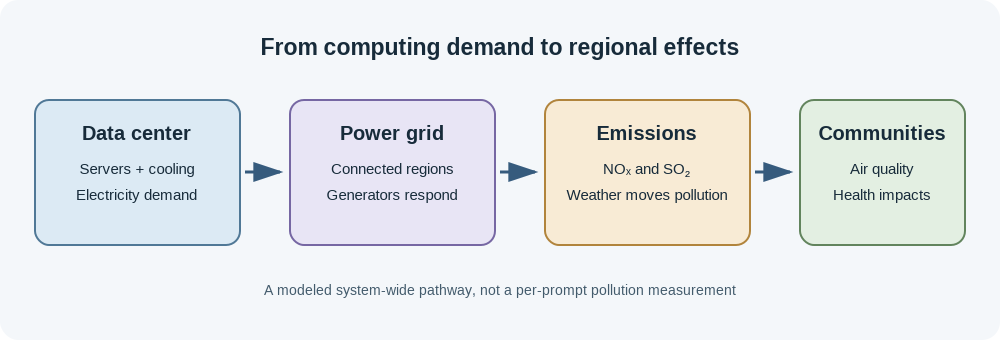
The facility’s location does not tell the whole story. Grid connections and weather can carry impacts to other regions.
How a request becomes a grid demand
When you ask a chatbot to summarize a document, the computation happens on servers in a data center. Those servers need electricity, as do the cooling systems that keep them within operating temperatures. The facility takes power from the grid. To meet total demand, grid operators call on generators, which can include fossil-fuel plants.
MIT’s analysis traced which generators responded to data-center demand hour by hour, then modeled how nitrogen oxides and sulfur dioxide contribute to smog and fine-particle pollution. The researchers linked those pollution estimates to health outcomes using epidemiological research. Their approach helps explain why impacts may occur far from a data center: electricity networks connect regions, and wind and atmospheric chemistry move pollutants. (MIT News)
| Part of the system | What happens | Why it matters to people |
|---|---|---|
| Data center | Servers and cooling systems draw electricity | More computing adds to electricity demand |
| Power grid | Generators respond to demand across connected regions | The source of power can vary by time and location |
| Air and weather | Emissions form or move as pollutants | Communities downwind may experience effects |
| Public health | Researchers estimate population-level risk | Results describe modeled patterns, not a diagnosis for any person |
What the study can and cannot tell us
The headline figure deserves attention, but it needs context. The researchers estimated the added impact of data-center electricity demand by comparing modeled power-system and pollution scenarios. It is not a measurement showing that a particular center caused a specific illness, and it does not tell us the impact of one chatbot question, image, or AI-assisted search.
The analysis also concerns 2023 electricity demand. Data centers and AI workloads have continued to change, so those numbers should not be treated as a current total or a forecast. The study is useful because it connects demand to the broader power system, including the locations where generators respond and pollution travels. (MIT News, Environmental Research Letters)
A separate Harvard study, reported by the Associated Press and NBC News, estimated that 403 of the largest U.S. data centers used 82 terawatt-hours of electricity between May 2024 and April 2025, producing about 28.3 million tons of carbon dioxide. That analysis examines greenhouse-gas emissions, a different measure from MIT’s estimates of air-pollution-related health effects. The studies should not be combined as if they measured the same outcome. (NBC News / AP, Nature Sustainability)
Questions to ask about a proposed data center
For a resident, small business, or local official, the project-level questions are more useful than trying to calculate the footprint of personal AI use. Ask:
- How much electricity will the facility need, and when? A projected annual total can hide periods of peak demand.
- Which generators are expected to supply that power? “Connected to renewable energy” can mean different things; ask how supply is matched over time and what happens when renewable output is low.
- Will new generation or grid upgrades be required? Find out who pays, what construction is planned, and whether household electricity bills could be affected.
- What air-quality and health impacts were assessed? Ask whether the analysis considers pollution from power plants beyond the immediate neighborhood.
- Will water use, emissions, and energy data be reported publicly? Ongoing reporting lets communities compare promises with actual operations.
These questions apply to planning and permitting discussions. The answers depend on local electricity sources, facility design, regulations, and the agreements in place. Communities need project-specific evidence before drawing conclusions about costs or health effects.
What you can do as an AI user
You do not need to stop using useful tools or feel responsible for a national energy system. You can avoid waste in the same way you do with other digital services: choose AI when it helps, use a simpler tool for a simple task, and skip repeated generation when the first result is already good enough. These steps are sensible habits, but they do not produce a reliable personal emissions estimate. Providers rarely disclose enough detail about each request, its model, data center, and electricity source to calculate one.
If you are choosing a service for work, ask the provider about its energy reporting and data-center operations. Treat broad sustainability claims as a starting point, then look for dated figures, independent reporting, and clear definitions. For a local proposal, follow the public process and request the facility’s power, water, and emissions plans.
AI’s benefits and infrastructure costs are both part of the same story. The MIT study offers a way to see beyond the data-center fence: electricity demand can have regional consequences. Better disclosure and project-level scrutiny give communities a stronger basis for deciding what development they want and what conditions it should meet.
Sources
This week’s AI news
Snapshot for 2026-11-17 through 2026-11-23.
Sentiment: AI is finding practical uses in health and engineering, but new research on data-center pollution and ongoing debates about AI’s capabilities underline the need to weigh benefits against real-world costs. (BBC, MIT, MIT)
People are talking about: When AI is useful in daily decisions, how to keep human oversight in high-stakes settings, and who bears the environmental and social costs of expanding AI infrastructure. (BBC, The Guardian, MIT)
Research & practical applications
-
AI is being used to flag possible lung cancer on scans: A Scottish doctor told the BBC that an AI tool helps radiology teams spot potential signs, while emphasizing that it supports rather than replaces clinical expertise. For patients, the useful takeaway is to ask how AI contributed to a result, not to treat a tool as a diagnosis. (BBC)
-
MIT researchers describe a way to make AI-designed circuits more efficient: Their SLIC method reportedly lets a small language model compete with more resource-intensive models on complex analog circuit design tasks. The research could eventually matter to people through cheaper or more efficient electronics, though it is not itself a consumer product. (MIT News)
Safety, security & governance
- UN talks on controlling autonomous weapons ended without agreement: The Guardian reported that international negotiations on rules for autonomous weapons collapsed. The issue is distant from most people’s daily routines, but it concerns the limits of delegating consequential decisions to automated systems and whether shared safeguards can be agreed internationally. (The Guardian)
Backlash, labor & trust
-
A South Korean education minister resigned amid an AI cheating scandal: The BBC reported that the resignation followed a university-exam cheating scandal. For students and educators, the practical challenge is making assessments that demonstrate a learner’s own understanding while setting clear rules for permitted AI assistance. (BBC)
-
Data-center electricity demand may affect air quality far from the facilities: An MIT study estimates that U.S. data-center electricity demand in 2023 was associated with about 650 premature deaths through air pollution, using models of power generation and pollution transport. This is a modeled estimate, not a count of individually traced deaths; it raises a local-life question for communities weighing new facilities: where will the electricity come from, and who bears the resulting impacts? (MIT News, Environmental Research Letters)
Five practical topics for this week’s issue
- Using AI for health information without mistaking it for a diagnosis: What to ask your clinician when AI assists with medical scans or advice.
- Spotting AI-assisted exam cheating and setting fair classroom rules: How students and teachers can use AI transparently while preserving genuine learning.
- The hidden local costs of AI tools: How data-center electricity demand can affect air quality, energy planning, and nearby communities.
- Who should control decisions made by autonomous weapons? Why international rules matter to public safety, even when the issue feels far removed from daily life.
- What AI research could mean for everyday electronics: How more efficient circuit design might eventually affect device costs and energy use, and why a research result is not yet a product.
Free weekly briefing
Get the next issue
Practical AI intelligence, delivered weekly.
Email address
By subscribing, you agree to receive the weekly newsletter. Unsubscribe at any time.Privacy details.
Open the signup page if the form does not load.