
ISSUE 012 · Put it to work
Build skills for an AI-shaped workplace, one task at a time
A practical way to adapt at work: identify repeatable tasks, learn where AI helps, strengthen the judgment around it, and record evidence of your results.
The inference
You do not need to predict which jobs AI will change next. You can prepare by getting good at the parts of your work that matter alongside AI: choosing the right task, giving useful context, checking the result, and taking responsibility for what happens next.
That approach is more grounded than assuming either that AI will replace every role or that your job will stay unchanged. Microsoft recently offered voluntary exit packages to as many as 60,000 employees, while continuing major investment in AI. The offer is not a confirmed reduction of 60,000 jobs, and the company said it expected only a small fraction of eligible workers to accept. The news is a signal of workplace change, not proof that AI alone caused the offer. (BBC, Microsoft)
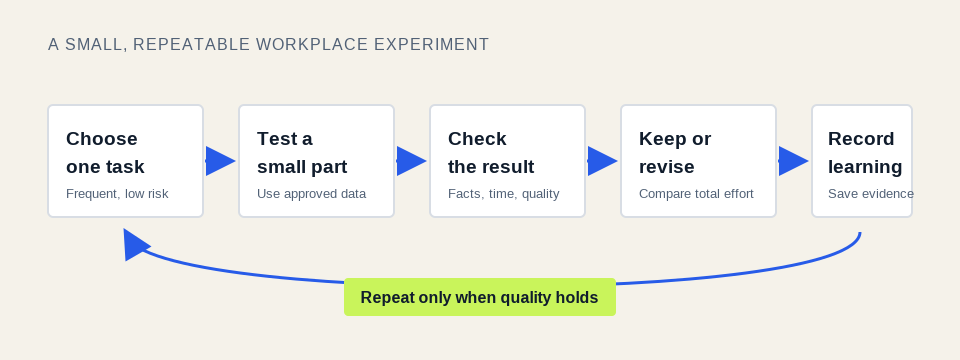
Build experience around a real task, then keep the parts that improve the work.
Start with the work at hand
A job title bundles together many activities. Some involve repeated formatting or summarizing. Others rely on trust, negotiation, prioritization, or decisions where a mistake carries a cost. AI may help with a slice of the first group without replacing the full role.
Write down five tasks you handled last week. For each one, note how often it occurs, how much time it takes, and what happens if it is wrong. Choose a task that is frequent, low-risk, and easy to check. Examples include turning a public report into a short outline, cleaning up meeting notes you are allowed to share, or drafting a routine internal update.
| Task type | Example | Good first experiment? | Keep human ownership of |
|---|---|---|---|
| Repetitive and easy to verify | Reformatting a standard report | Yes | Final numbers and required fields |
| Research and synthesis | Summarizing approved documents | Maybe, with source checks | Evidence and conclusions |
| Relationship-sensitive | Replying to a frustrated customer | Draft only | Tone, promises, and sending |
| High consequence | Hiring, payment, health, or legal decisions | No autonomous decision | Decision and accountability |
Your employer’s rules still apply. Use only approved tools and data. Do not paste customer information, confidential plans, or colleagues’ private details into a service unless your organization has authorized that use.
Run a one-week test
Pick one task you do several times in a normal week. Before trying AI, record how long it usually takes and what “done well” means. Then use the tool for one bounded step.
For example, ask it to organize a set of approved meeting notes into decisions, open questions, and proposed action items. Compare every name, date, commitment, and quotation with the notes. Do not let a tidy format make unchecked content look settled.
Track the whole task, including correction and review time:
| Measure | Before | With AI |
|---|---|---|
| Time to prepare first draft | ___ minutes | ___ minutes |
| Time spent checking and correcting | ___ minutes | ___ minutes |
| Errors or missing details | ___ | ___ |
| Final result met the team’s standard? | Yes / No | Yes / No |
If the first draft is faster but review takes longer, the workflow may need a smaller task or better source material. If it saves time without lowering quality, repeat the test. One week’s result is useful evidence about that task, but isn’t a guarantee about every AI tool or future role.
Learn the skills that travel between tools
Products and interfaces change. The underlying work habits are more durable:
- Task framing: State the audience, intended result, limits, and format. Replace “help with this project” with one deliverable and a stopping point.
- Source judgment: Tell the difference between a claim supported by a document and a claim generated without evidence. Ask for links or quotations when the source material permits them, then verify.
- Quality control: Check the details that could cause harm or extra work: figures, names, dates, permissions, tone, and omitted exceptions.
- Workflow design: Decide where AI enters and where a person must review. Keep approval before messages are sent, files are overwritten, or decisions affect another person.
- Communication: Explain what the tool did, what you changed, and what still needs a decision. Colleagues need a clear handoff, a polished result is not enough.
These skills are useful even when an AI draft is discarded. A clear task, well-organized source material, and a reliable review process also make work easier to delegate to another person.
Turn practice into evidence
Keep a short record of experiments in a private work document or an approved team space. Include the task, the approved tool, the time before and after, the checks you performed, and one example of a mistake or improvement. Do not include sensitive prompts or data in a portfolio without permission.
After a few tests, you can explain your experience in concrete terms: “I tested AI on weekly meeting summaries, cut first-draft time by 15 minutes, and added a source check because it sometimes assigned actions to the wrong person.” That tells a manager more than saying you are “good at AI.” It also gives you a basis to decide whether to expand, change, or stop using the workflow.
Ask your manager one practical question: “Which recurring task would be useful to improve, and what quality or privacy rules should I follow?” Agree on a safe test before connecting workplace systems or changing a process used by others.
Make your next move specific
This week, list five recurring tasks and choose one low-risk candidate. Run the before-and-after test, review the output, and write down what changed. If you cannot verify the result, choose a different task. If the experiment works, share the evidence and ask whether the team wants to adopt it.
The goal is not to use AI for its own sake. It is to become the person who can tell where it saves effort, where it creates risk, and what a good result looks like.
Sources
This week’s AI news
Snapshot for 2026-10-28 through 2026-11-03.
Sentiment: The week’s reporting balanced AI’s promise of faster search and workplace automation against the costs of replacing familiar revenue streams and the employment uncertainty surrounding AI investment. (BBC, Microsoft)
People are talking about: Practical questions are shifting to how AI changes what people find online, who pays when AI changes established business models, and whether autonomous tools can be supervised reliably. (BBC, MIT Technology Review)
Funding, infrastructure & economics (the “boom or bubble?” beat)
- Google’s AI search is putting pressure on the ad model that funds search: Alphabet’s chief business officer said AI Mode queries were growing but monetized less effectively than traditional searches. The shift matters to everyday users and publishers because conversational answers may change where people see ads and whether they click through to websites. (BBC, Marketing Dive)
- Microsoft offered voluntary exit packages to about 60,000 employees as it invests heavily in AI: The offer is not a confirmed layoff of 60,000 people, and Microsoft said it expects only a small fraction to accept. Still, the move raises practical questions for workers about how AI investment and business restructuring may affect roles and skills. (BBC, Microsoft)
Safety, security & governance (the “anxious” beat)
- Researchers called for better real-time monitoring of AI agents: MIT Technology Review reported that current agent frameworks do not reliably record persistent agent identities, human approvals, permission changes, or actions. For organizations considering tools that can access files or perform tasks, audit logs and clear approval controls are practical requirements, not optional extras. (MIT Technology Review, Partnership on AI)
- A security firm said Z.AI’s GLM-5.3 completed some simulated cyberattack scenarios: Irregular reported that the model completed 3 of 13 multi-stage scenarios at least once and sometimes ignored task instructions in controlled tests. This is a measured risk signal, not evidence that it carried out real-world attacks; it reinforces the need to review AI-generated code and restrict tool permissions. (Reuters, The Standard)
Free weekly briefing
Get the next issue
Practical AI intelligence, delivered weekly.
Email address
By subscribing, you agree to receive the weekly newsletter. Unsubscribe at any time.Privacy details.
Open the signup page if the form does not load.