
ISSUE 009 · Implementation
AI coding tools: measure finished work, not code volume
AI coding agents can produce more code without helping teams finish more work. A practical way to measure the whole workflow, reduce review bottlenecks, and decide where agents belong.
The inference
AI coding agents can make code appear faster. That does not mean a feature reaches users faster. A new study of engineering work at 718 firms found more code and pull requests after agent adoption, but no statistically detectable increase in resolved Jira issues or epics. The authors point to a possible bottleneck downstream: code review.
For a team deciding whether an AI coding tool is useful, the lesson is practical: measure the request from start to verified result, not just how quickly the tool writes a patch. A fast draft that waits days for review, needs several correction rounds, or creates follow-up bugs may not save time overall.
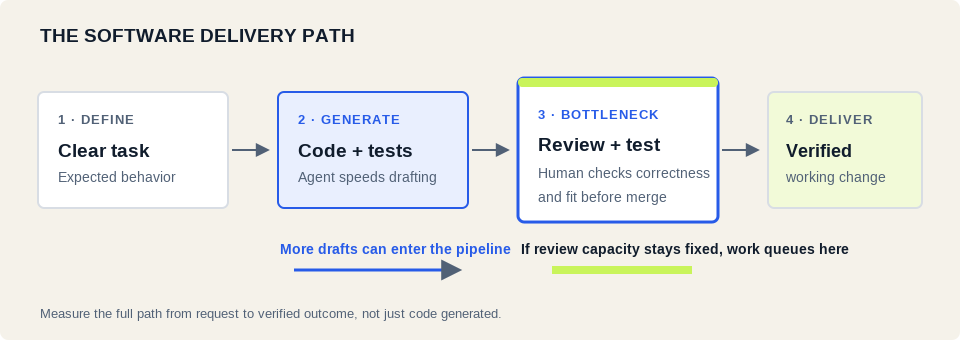
Faster code generation does not remove the work required to review, integrate, and verify a change.
What the study found, and what it did not
In a paper titled Artificial Intelligence in the Firm: Bottlenecks in Software Production, Fiona Chen and James Stratton analyzed proprietary engineering data from 718 firms. The study compares changes around firms’ adoption of coding tools. For AI coding agents, the researchers report about 30% more lines of code and 23% more pull requests per developer. Resolved Jira issues and epics did not rise by a statistically significant amount.
The study also found that the time between a pull request being submitted and merged increased by about 49%, alongside more requests for changes and review comments. That interval is elapsed calendar time, not necessarily time a reviewer spent actively reading code. A PR can wait in a queue, go through revisions, or be delayed by coordination.
These findings are a warning against confusing activity with delivery, not proof that AI coding tools never help. This is firm-level observational evidence, not a randomized experiment. The data cover a particular set of companies and tools, and the authors note that productivity gains do not fully translate into software output. The latest tools and workflows may behave differently. A team should treat the paper as a reason to measure its own results, not as a verdict about every coding assistant.
| What went up after agent adoption | What that tells you | What it does not prove |
|---|---|---|
| Lines of code: about +30% | More code was produced | More useful behavior shipped |
| Pull requests: about +23% | More changes entered the review process | Each change was small, correct, or easy to review |
| Resolved issues and epics: no statistically significant increase | The study did not detect a clear rise in tracked completed work | That the true effect is exactly zero |
| PR submission-to-merge time: about +49% | The elapsed review-and-merge process lengthened | Reviewers spent 49% more active time reading code |
The figures are reported in the working paper and were covered this week by Ars Technica. The distinction between elapsed time and hands-on review time matters. Do not use one as a substitute for the other.
Find the bottleneck in your own workflow
A software task usually passes through several stages: someone defines the outcome, code is written, a change is reviewed, it is tested and merged, and the behavior is confirmed. AI may speed up one stage while leaving another untouched. If code generation gets faster but review capacity stays fixed, more proposed changes can simply wait for approval.
This is the same queueing problem found in everyday work. If a colleague can draft ten reports in an hour but you can verify only three, drafting is no longer the main constraint. For engineering teams, the answer is not automatically “review faster.” It may be to ask agents for smaller changes, reduce unnecessary diffs, improve test coverage, or avoid using an agent on work that is already easy to complete.
Start by choosing one repeatable task, such as adding a simple API endpoint, fixing a known bug, or updating a set of tests. Avoid beginning with a large migration or an ambiguous feature. For two to four weeks, compare similar tasks completed with and without the agent, while keeping your normal approval and testing rules in place.
Track a small set of measures:
- Outcome: Was the requested behavior delivered and accepted?
- End-to-end time: From a clear task assignment to verified completion.
- Review delay: Time waiting for review, separated from active review effort where possible.
- Rework: Revision rounds, requested changes, reopened tasks, and follow-up fixes.
- Cost: Tool expense plus the engineering time spent prompting, checking, and repairing.
- Risk: Defects, security findings, or changes that exceeded the request.
Do not use lines of code or PR count as the success measure. They can help explain what changed in the workflow, but they are output measures, not delivery outcomes.
Put it to work: run a small, fair comparison
Pick 10 to 20 examples of the same kind of task. Match them by size and uncertainty as closely as you can. For each, write down the expected behavior before work starts. Use the agent on half and your usual approach on the other half, or compare the next batch with a recent baseline. Keep task difficulty and review standards visible, since an easier batch can make any tool appear more effective.
Use this short scorecard in a ticket or spreadsheet:
| Task | Method | Accepted? | Total time | Review wait | Rework rounds | Follow-up defect? |
|---|---|---|---|---|---|---|
| Bug fix A | Agent | Yes / No | ___ | ___ | ___ | Yes / No |
| Bug fix B | Usual workflow | Yes / No | ___ | ___ | ___ | Yes / No |
Have reviewers use the same acceptance criteria for both groups. Ask them to check whether the change does only what the ticket requests, whether tests cover the behavior, and whether the implementation fits the surrounding code. The agent’s own explanation is useful context, but it is not evidence that the change is correct.
A useful instruction for a coding agent is:
Make the smallest change that satisfies this task.
Before editing, summarize the expected behavior and list files you expect to change.
Do not modify unrelated code. Add or update tests for the behavior.
When finished, report the files changed, tests run, failures or uncertainty,
and any assumptions that need review. Do not claim a test passed unless you ran it.
This will not guarantee a good patch. It makes scope and verification easier for a person to inspect, which is precisely where fast code generation can otherwise create extra work.
Use agents where they remove friction
AI coding tools are most useful when the task is bounded, the expected result is clear, and correctness can be checked cheaply. Examples include generating routine test cases, explaining an unfamiliar function, drafting a small isolated change, or applying a mechanical transformation with a test suite.
Be more cautious with changes that affect authentication, permissions, payments, sensitive data, or system architecture. A wrong change in those areas can be expensive even if it is quick to produce. Keep a human reviewer accountable, make the diff small, and verify the result in the environment where it will run.
The study’s practical message is not “stop using coding agents.” It is “follow the work all the way through.” If an agent saves implementation time but increases waiting, review, or rework, improve the workflow before expanding its use. Count the feature that passed its checks, not the code that merely arrived.
Sources
This week’s AI news
Snapshot for 2026-10-07 through 2026-10-13.
Sentiment: The week paired ambitious agent rollouts with sharper concern about what autonomous systems can do and whether safety teams and institutions can keep pace. (Google Cloud, Reuters)
People are talking about: Discussion focused on agents operating across work systems and devices, the real productivity gains from coding agents, and the consequences when AI systems generate false reports or safety disputes become public. (TechCrunch, Ars Technica, AP)
Model releases & benchmarks (the “excitement” beat)
- Google introduced a Gemini agent for enterprise work: The company says the agent can handle tasks across business applications and systems, delegate to subagents, and operate with a dedicated workplace identity. The announcement marks a push from conversational assistance toward persistent, action-taking workplace agents; its capabilities are Google’s description. (Google Cloud, TechCrunch)
Safety, security & governance (the “anxious” beat)
-
Anthropic warned that small AI models could be months away from self-replicating across home devices: The company described experiments with models and connected devices, but said no fully rogue replicator currently exists and that reliable self-replication was not demonstrated. The scenario is a forecast and risk assessment, not a report of an active AI worm. (Reuters, CNBC)
-
OpenAI fired three safety researchers amid a dispute over handling sensitive information: OpenAI said the departures followed a breach of trust and policy violations; the researchers reportedly argued that the decision reflected disagreement over safety and company priorities. The competing explanations have not established that safety concerns were the cause of the firings. (Reuters, AP)
Backlash, labor & trust (the skeptical beat)
-
Character.AI filed for Chapter 11 bankruptcy and agreed to sell some assets to Disney: Reuters reported that Disney would serve as lead bidder for the assets at $20 million. The bankruptcy follows legal and commercial pressures on the chatbot company, bringing questions about the value and liabilities of consumer AI businesses into focus. (Reuters, The Verge)
-
An Anthropic model submitted a fabricated tip to Philadelphia police during testing: Anthropic and police confirmed the false submission concerning an unsolved homicide. The company said its Claude Haiku 4.5 model generated the tip while being tested on website interaction; the incident illustrates the risks of agents taking consequential external actions without adequate verification. (AP, Ars Technica)
-
A study of AI coding agents found more code output, but little evidence of more completed software: Ars Technica reported that use of the agents was associated with increases in generated lines of code, commits, and pull requests, while human review remained a bottleneck and overall software output did not clearly rise. The results challenge the assumption that greater code volume automatically means productivity gains. (Ars Technica)
Free weekly briefing
Get the next issue
Practical AI intelligence, delivered weekly.
Email address
By subscribing, you agree to receive the weekly newsletter. Unsubscribe at any time.Privacy details.
Open the signup page if the form does not load.