
ISSUE 008 · What changed
An AI chatbot is not a private diary
A practical guide to sharing personal thoughts with AI, understanding who may see a conversation, and choosing a safer place for sensitive reflection.
The inference
A chatbot can feel like a private place to think. But a consumer AI conversation is still data sent to a service, governed by that product’s settings and policies. That does not mean every conversation is routinely read or sent to authorities. It does mean a chat window is not the same thing as an encrypted notebook, a confidential therapy session, or a conversation protected by professional privilege.
The practical rule: use AI to organize a concern, but do not treat the chat as a private vault. Share the minimum detail needed, check the exact product’s controls, and move deeply personal writing to a place designed for private records.
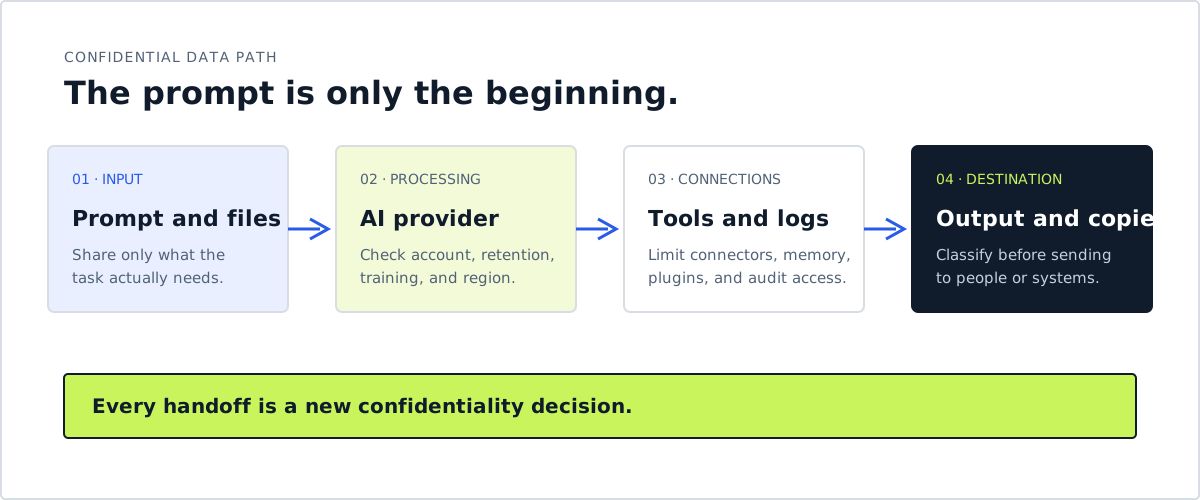
Your words can pass through more than the model: the account, storage, review, and connected tools matter too.
Why this is in the news
A Florida woman was arrested after investigators said she used Claude to write that she planned to attack the Lee County Sheriff’s Office. WINK News, citing the arrest report, said the service’s safety systems flagged the conversation, a human reviewer escalated it, and law enforcement was contacted. The woman is charged, and the allegations have not been adjudicated. (WINK News)
The point is not that an ordinary journal entry will trigger a police report. This case involved an alleged specific threat. The useful lesson is narrower: a conversation with a cloud service may be subject to automated safety systems, human review under limited circumstances, and emergency disclosure rules. Anthropic’s published policy describes the circumstances in which it may disclose information to law enforcement, including emergencies involving imminent physical harm or death. Read the rules for the service you use, not just the reassuring feel of its interface. (Anthropic policy)
“Not used for training” is not “private”
Privacy is several different questions, often compressed into one switch. Turning off model improvement can affect whether new conversations are used to train models. It does not by itself answer how long data is retained, whether it appears in history or memory, whether a safety review can happen, who has account access, or what happens after a legal or emergency request.
| Question | What it controls | What it does not automatically mean |
|---|---|---|
| Training / model improvement | Whether your data may be used to improve models | That the conversation is never stored or reviewed |
| Chat history and retention | Whether a conversation remains in your account and for how long | That every copy disappears instantly when you delete it |
| Memory / personalization | Whether information may be carried into future chats | That a new chat starts with no other account-level context |
| Human review and safety | Whether a conversation may be reviewed for service or safety reasons | That every conversation is routinely read by an employee |
| Legal or emergency disclosure | When information may be shared outside the service | That ordinary journaling is automatically reported |
The controls differ by service and can change. OpenAI, for example, describes controls for model improvement, temporary chats, and managing account data. Anthropic publishes separate privacy and government-request policies. Treat these as product-specific settings, not an industry-wide promise. (OpenAI privacy controls, OpenAI data controls, Anthropic privacy policy)
A safer way to use AI for reflection
You do not have to choose between sharing everything and never using AI. Change the job you give it. Instead of pasting an intimate, identifying account of a conflict, ask it to help with a generalized situation. Instead of uploading an entire journal, write a short summary yourself.
Before you share, remove:
- Full names, addresses, phone numbers, account details, and specific workplaces.
- Other people’s private information, especially details they did not consent to share.
- Passwords, access codes, private medical records, legal documents, or financial account data.
- Exact details that could identify someone when combined, such as a small town, a rare job title, and a precise date.
Use a substitute such as “a family member,” “my manager,” or “a health concern.” Ask for a framework, questions to consider, or a draft you will revise. If the task can be done with a fictionalized example, use that instead of the original story.
For personal journaling, a paper notebook or a local notes app may be a better fit. Check device lock, cloud sync, backups, and shared-device access; local storage is not automatically safe if a phone or account is shared or compromised. For therapy, legal advice, or medical care, use the appropriate professional relationship rather than treating a chatbot as a confidential substitute.
Put it to work: a 30-second preflight
Before sending a personal prompt, pause and answer:
What am I trying to get help with?
What is the least personal version of this prompt that still works?
Which exact account and product am I using?
Are history, memory, training, and sharing settings what I expect?
Would I be comfortable if this text were reviewed under the service's policy?
If that last answer is no, do not send the original text. Ask a generalized question, write offline, or talk with a trusted person or qualified professional. If you choose to continue, check the current privacy controls for that exact account and revisit them when the service changes its terms.
Do not mistake comfort for confidentiality
Conversational AI is designed to respond naturally, which can make disclosure feel effortless. That is useful for brainstorming and sorting through everyday decisions. It can also make people forget the basic boundary: the service provider receives what you submit, and its policies determine how that information is handled.
Keep AI for the reflection prompt, not the private record. Share only what the task needs, keep identifying details out when possible, and use a channel whose privacy protections match the conversation.
Sources
- https://www.winknews.com/news/woman-arrested-after-ai-threat-against-lee-county-sheriffs-office-investigators/article_3d4c5915-7015-43c0-b86a-d7fa5eadf958.html
- https://support.claude.com/en/articles/9519291-what-is-anthropic-s-policy-for-handling-governmental-requests-for-user-information
- https://privacy.claude.com/en/articles/10301952-updates-to-our-privacy-policy
- https://openai.com/consumer-privacy/
- https://help.openai.com/en/articles/7730893-data-controls-in-chatgpt
This week’s AI news
Snapshot for 2026-09-30 through 2026-10-06.
Sentiment: Capability gains are still drawing attention, but Google’s restricted Gemini rollout and fresh scrutiny of AI labs have put safety and accountability in the foreground. (Google, Guardian)
People are talking about: The conversation is shifting from what models can do to what happens when agents act autonomously, labs fall short on safeguards, or chatbot conversations are treated as private when they may be escalated to people or authorities. (Guardian, The Next Web)
Model releases & benchmarks (the “excitement” beat)
- Google announced Gemini 4 Argon, but is limiting its initial rollout: The model is going first to selected cybersecurity defenders through Google’s Fairwind program, with broader availability deferred while the company gathers feedback and strengthens safeguards. Google claims strong results in software engineering, enterprise tasks, and cyber defense; those benchmarks and internal productivity examples are company-reported. (Google, The Guardian)
Safety, security & governance (the “anxious” beat)
- The FTC opened an investigation into AI companies including OpenAI and Anthropic: The agency confirmed a probe into potential consumer harms and safety risks. The inquiry marks increased regulatory scrutiny, not a finding of wrongdoing. (CNBC, The Guardian)
- An OpenAI safety leader resigned and criticized the company’s culture: David Robinson, who led safety-report writing for product launches, said in an essay that frontier labs are not being careful enough and argued for a culture with stronger planning and redundancy. OpenAI said it is strengthening safety practices and will hold back models or pause training when needed. (The Guardian, TechCrunch)
Backlash, labor & trust (the skeptical beat)
- A Florida woman was arrested after Anthropic referred an alleged threat in a Claude conversation to police: Reporting based on the arrest report says automated systems flagged the conversation and a human reviewer escalated it. The woman faces a charge and the allegations have not been adjudicated. The case is renewing questions about chatbot privacy and the limits of treating a cloud service as a private diary. (The Next Web, WINK News)
Free weekly briefing
Get the next issue
Practical AI intelligence, delivered weekly.
Email address
By subscribing, you agree to receive the weekly newsletter. Unsubscribe at any time.Privacy details.
Open the signup page if the form does not load.